
Building the Right Organization for AI: A Blueprint for Success
Artificial Intelligence (AI) is no longer a futuristic concept; it is a key driver of business transformation across industries. However, the success of AI initiatives depends not only on advanced technology but also on building the right organizational structure to support AI-driven innovation. Companies that fail to set up the right AI organization often struggle with scalability, governance, and cross-functional collaboration.
In this blog post, we will explore how to build an AI-ready organization, the key roles needed, and the best practices for fostering an AI-driven culture.
1. Align AI with Business Strategy
Before structuring an AI team, businesses must define why they need AI and how it aligns with their strategic goals. AI should not exist in isolation but should directly contribute to measurable business outcomes.
Key Considerations:
• What are the primary business objectives AI should support? (e.g., cost reduction, revenue growth, customer experience)
• Which departments will benefit from AI? (e.g., marketing, finance, operations)
• Should AI be centralized, decentralized, or hybrid across the organization?
Once the strategic direction is clear, businesses can design an AI team structure that fits their needs.
2. Define the Right AI Team Structure
There is no one-size-fits-all approach to organizing AI teams, but there are three common models:
1. Centralized AI Team
• AI expertise is housed in a single unit that serves the entire organization.
• Works well for companies just starting their AI journey.
• Ensures standardization and strong governance but may lack flexibility.
Best for: Companies with limited AI expertise that need centralized control.
2. Decentralized AI Model
• AI capabilities are distributed across different business units.
• Encourages domain-specific AI innovation but may lead to silos.
• Works well when AI adoption is mature across departments.
Best for: Large organizations where AI is embedded in multiple functions.
3. Hybrid AI Model (Hub-and-Spoke)
• A central AI team (hub) sets the overall AI vision, standards, and governance.
• Business units have their own AI specialists (spokes) who tailor AI to department needs.
• Balances standardization with flexibility.
Best for: Enterprises scaling AI adoption while ensuring governance.
For most companies, the hybrid model is ideal as it enables AI governance while promoting agility.
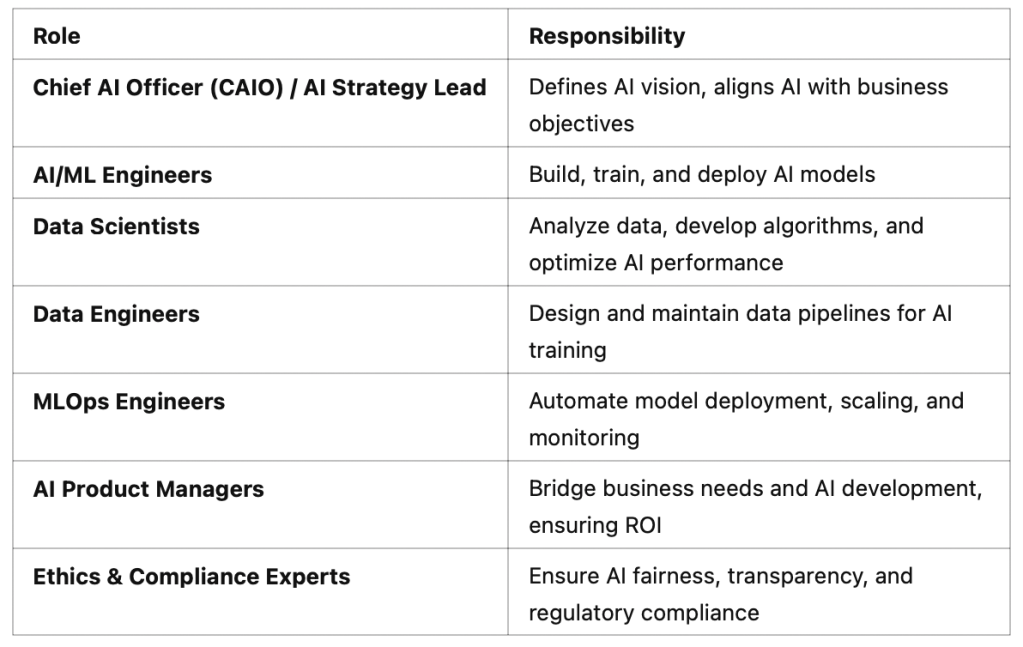
3. Key Roles in an AI Organization
A successful AI organization requires a blend of technical, strategic, and operational roles.
Core AI Team Roles
Cross-Functional Roles Supporting AI
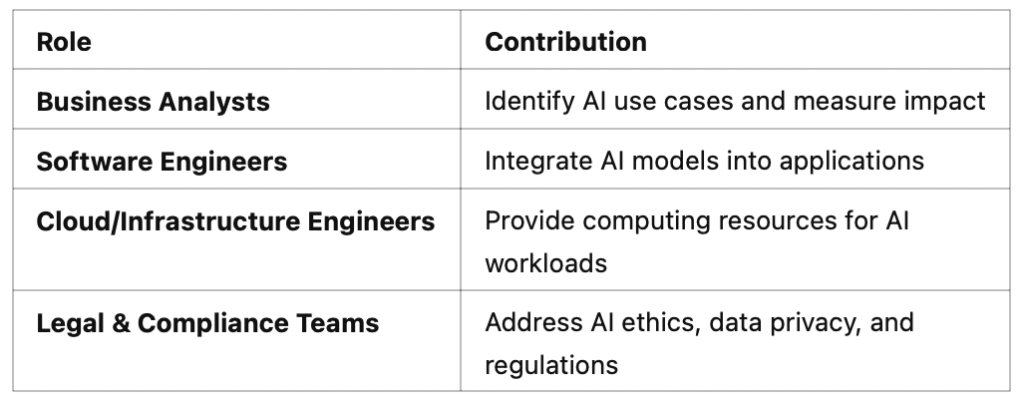
A well-structured AI team combines technical AI expertise with business acumen to drive real impact.
4. Foster Cross-Functional Collaboration
AI does not operate in isolation. It requires collaboration between AI teams, IT, and business units.
Best Practices for Cross-Functional AI Success:
• AI & Business Partnerships: Encourage AI product managers to work closely with business leaders to ensure AI meets real-world needs.
• AI Training for Non-Technical Staff: Enable employees to understand AI’s capabilities and limitations.
• Agile & Iterative Development: Adopt an MVP (Minimum Viable Product) approach to test AI models before full-scale deployment.
• AI Governance Committees: Establish governance teams to oversee AI strategy, ethics, and compliance.
Breaking silos and ensuring AI alignment across departments is key to scaling AI adoption successfully.
5. Build an AI-Driven Culture
Technology alone does not drive AI transformation—people do. Creating an AI-driven culture is essential for long-term success.
How to Promote AI Adoption Across the Organization:
✅ Executive Leadership Buy-In: Ensure C-level executives champion AI initiatives.
✅ AI Literacy Programs: Offer AI training for employees at all levels to build confidence in AI-driven decision-making.
✅ Encourage AI Experimentation: Provide teams with sandbox environments to test AI without fear of failure.
✅ Recognize AI Contributions: Reward employees who successfully leverage AI for business improvements.
✅ Promote Responsible AI Use: Educate teams on AI ethics, bias mitigation, and regulatory compliance.
A company that embraces AI as part of its culture will outperform competitors that view AI as just another IT project.
6. Establish AI Governance & Risk Management
AI comes with risks—bias, privacy violations, and unintended consequences. Organizations must proactively address these challenges.
Key Elements of AI Governance:
• Ethical AI Frameworks: Establish clear principles for fairness, transparency, and accountability.
• AI Model Audits: Regularly evaluate AI models for bias and accuracy.
• Regulatory Compliance: Ensure AI follows global regulations (e.g., GDPR, AI Act).
• AI Explainability Tools: Use techniques like SHAP, LIME, or model cards to make AI decisions interpretable.
A robust AI governance framework builds trust with customers, regulators, and stakeholders.
7. Measure AI Success with the Right KPIs
To justify AI investments, organizations must track Key Performance Indicators (KPIs).
AI Performance Metrics:
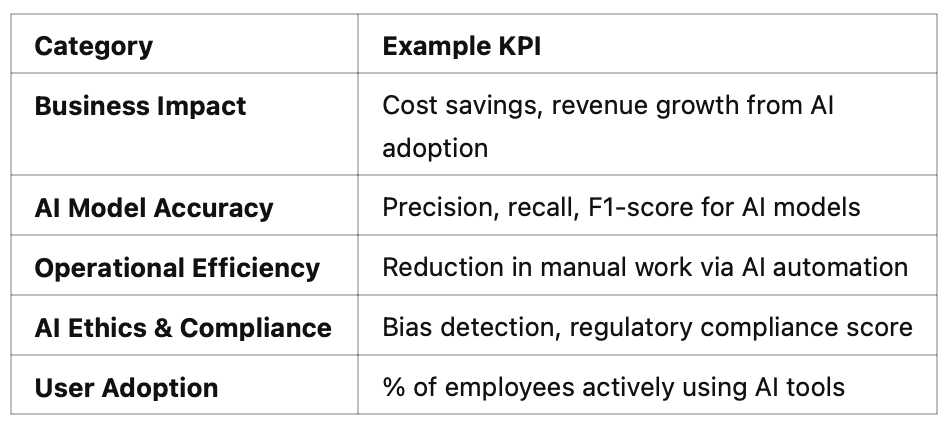
Continuous monitoring and iteration ensure AI delivers measurable business value.
Conclusion: A Roadmap for AI-Ready Organizations
Building the right AI organization is not just about hiring data scientists—it requires a holistic strategy combining technology, people, and processes.
Key Takeaways:
✅ Align AI initiatives with business goals.
✅ Choose the right AI team structure (centralized, decentralized, or hybrid).
✅ Hire a balanced team of AI experts, business leaders, and compliance officers.
✅ Promote cross-functional collaboration between AI teams and departments.
✅ Foster an AI-driven culture through training and executive buy-in.
✅ Implement AI governance to ensure fairness and compliance.
✅ Track AI performance KPIs to measure impact.
Organizations that get AI strategy and execution right will lead in the AI-powered future.
 Utkan Menteş