
Artificial Intelligence (AI) is transforming industries by enhancing efficiency, enabling data-driven decision-making, and unlocking new revenue streams. However, successfully integrating AI into a business requires a well-defined strategy aligned with organizational goals. Without a clear roadmap, AI initiatives risk becoming isolated experiments with limited impact.
This blog post explores how to develop a corporate AI strategy and key considerations to ensure its success.
1. Define Business Objectives and AI Use Cases
The first step in an AI strategy is aligning AI initiatives with business objectives. Instead of adopting AI just for the sake of innovation, organizations should identify specific business problems AI can solve.
Key Considerations:
• What are the company’s top strategic priorities?
• How can AI improve efficiency, reduce costs, or enhance customer experiences?
• What are the high-impact AI use cases relevant to the industry?
Examples of AI Use Cases in Different Industries:
• Banking & Finance: Fraud detection, credit risk assessment, AI-powered chatbots for customer service
• Retail & E-commerce: Personalized recommendations, demand forecasting, automated inventory management
• Healthcare: AI-assisted diagnostics, predictive patient care, drug discovery
• Manufacturing: Predictive maintenance, quality control, robotic automation
By defining clear AI use cases, businesses can prioritize investments and measure the ROI of AI adoption effectively.
2. Assess Data Readiness and Infrastructure
AI thrives on high-quality data. Before implementing AI, organizations must evaluate their data availability, quality, and governance.
Key Considerations:
• Do we have structured and unstructured data in sufficient quantity?
• How is data collected, stored, and managed across different departments?
• Are there data privacy and compliance concerns (e.g., GDPR, CCPA)?
• Do we have the right data infrastructure (cloud vs. on-premise solutions)?
A well-organized data strategy ensures AI models can be trained effectively. Companies should invest in data lakes, pipelines, and governance frameworks to ensure high-quality data is available for AI systems.
3. Build or Buy: Selecting the Right AI Technology Approach
Organizations must decide whether to build AI solutions in-house or leverage third-party AI tools and platforms.
Option 1: In-House AI Development
• Suitable for large enterprises with skilled AI teams
• Offers full control over customization and intellectual property
• Requires significant investment in AI talent, computing power, and R&D
Option 2: AI-as-a-Service (AIaaS) and Prebuilt Solutions
• Faster and more cost-effective for businesses without AI expertise
• Examples: OpenAI’s GPT, Google Vertex AI, AWS AI services, and Microsoft Azure AI
• Ideal for companies that need scalable AI without heavy R&D costs
Organizations should evaluate their internal capabilities and choose the right approach based on their long-term AI vision.
4. Develop AI Talent and Build a Cross-Functional Team
AI implementation is not just an IT initiative—it requires cross-functional collaboration between data scientists, engineers, business leaders, and domain experts.
Key Considerations:
• Do we have the right AI skills in-house?
• Should we hire AI talent or upskill existing employees?
• How can we foster collaboration between technical and business teams?
Roles in a Corporate AI Team:
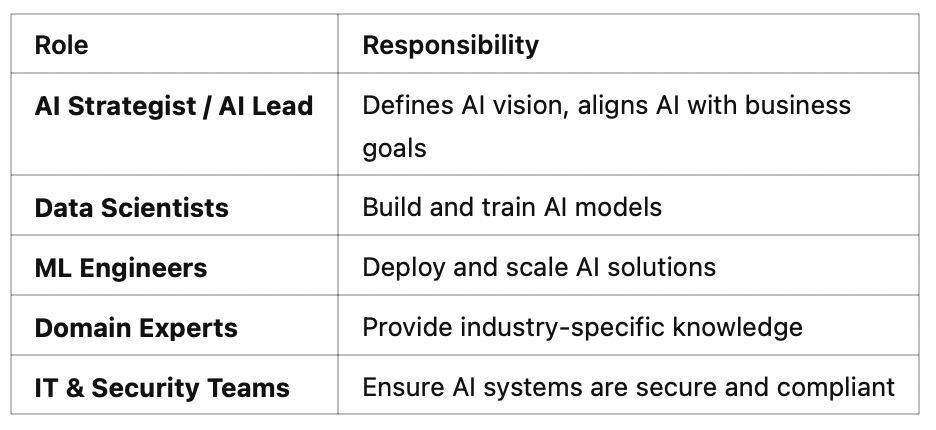
Many companies also partner with AI consultants or universities to accelerate AI talent development.
5. Establish Ethical AI Governance and Compliance
AI introduces ethical and regulatory challenges that organizations must proactively address.
Key Considerations:
• Are AI models transparent and explainable?
• How do we mitigate bias in AI models?
• Are AI decisions fair and non-discriminatory?
• How do we ensure data privacy and security?
To build trust in AI, companies should implement AI ethics guidelines and ensure compliance with regulatory frameworks like GDPR (Europe), CCPA (California), and AI Act (EU).
One best practice is using Explainable AI (XAI) techniques to make AI-driven decisions more interpretable to stakeholders.
6. Pilot, Scale, and Measure AI Success
Successful AI strategies follow a test-and-learn approach, starting with small pilots before scaling across the enterprise.
AI Implementation Roadmap:
1. Identify a high-value AI use case (e.g., automated customer support)
2. Develop a proof of concept (PoC) to validate AI feasibility
3. Measure AI performance using key metrics (e.g., accuracy, cost savings)
4. Scale AI deployment after successful PoC validation
5. Continuously optimize AI models based on real-world feedback
Organizations should define clear KPIs such as cost reduction, revenue growth, customer satisfaction improvements, and operational efficiency gains to measure AI success.
7. Foster a Culture of AI Adoption and Innovation
AI adoption is not just a technological shift—it requires a cultural transformation within the organization.
Key Strategies for AI Adoption:
• Executive sponsorship: Leadership must champion AI initiatives.
• Employee training & AI literacy programs: Equip teams with AI skills.
• AI governance frameworks: Set clear policies for AI ethics and compliance.
• Encourage experimentation: Allow teams to explore AI-driven innovation.
Organizations that embrace an AI-first mindset gain a competitive edge by fostering a culture of continuous learning and adaptation.
Conclusion: The Path to AI-Powered Business Transformation
Building an AI strategy is not a one-time effort but an ongoing journey. Companies that take a structured, strategic approach to AI—aligning technology with business goals, investing in data and talent, ensuring ethical AI governance, and fostering a culture of innovation—will be well-positioned to unlock AI’s full potential.
By following these seven key steps, organizations can move beyond AI hype and create a scalable, impactful AI strategy that drives sustainable growth.
 Utkan Menteş